

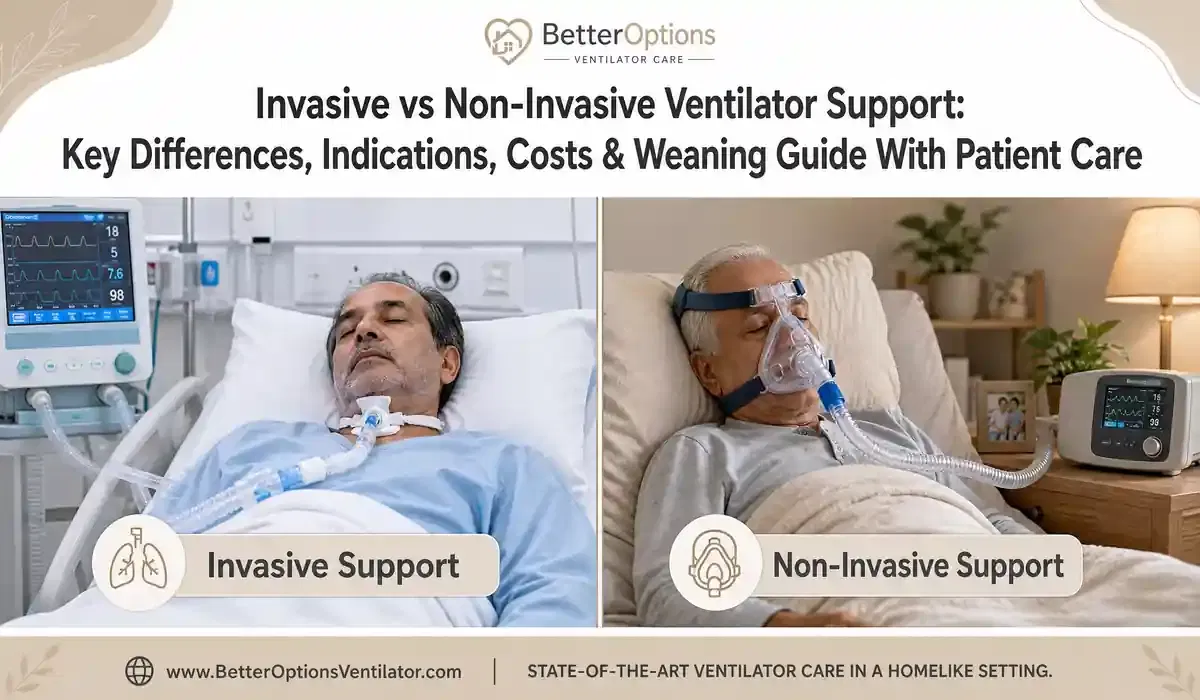
Many patients and their family members inquire about invasive and non-invasive ventilator support and which support the patient may require. In this article, I will explain both types of ventilation briefly, in what conditions we need one type over the other, what the differences are, how and when to wean off, and what the associated costs are.
What is Invasive Ventilation Care (IV)
Invasive mechanical ventilation is the process where patients undergo a small procedure of inserting an endotracheal or tracheostomy tube through their trachea to pass air to the airways. This tube is connected to the ventilator and serves as a medium to pass air to the lungs to assist breathing.
Invasive ventilation is generally divided into 2 categories based on the placement of the tube.
- Endotracheal Intubation – a tube is inserted through the nose or mouth into the trachea if ventilation is required for a short time, like in surgeries or emergencies.
- Tracheostomy – a tube is directly inserted into the trachea through an opening made surgically in the neck. This approach is used if ventilation is needed for the long term.
IV is specifically preferred in severe cases of respiratory failure, including:
- Medical conditions where noninvasive ventilation is unsuccessful
- ARDS – Acute Respiratory Distress Syndrome
- Airway obstruction
- Coma or severe shock
- Surgeries when anesthesia is needed
- The patient is unconscious
What is Noninvasive Ventilation Care (NIV)
Noninvasive ventilation, or NIV, is a common type of ventilation that does not require any intubation or sedation. During ventilation, the machine passes a controlled mixture of oxygen and air into the lungs with every breath of the patient, which aids the opening of airways and breathing.
Patients can get noninvasive mechanical ventilation in 2 forms depending on their condition
- CPAP (Continuous Positive Airway Pressure) – machine continuously pushes higher pressure into the airways of the patient and is ideal for conditions where patients have spontaneous breathing.
- BIPAP (Bilevel positive airway pressure) – the machine uses 2 different levels of pressure for inhaling and exhaling, adjusted either manually or automatically as per the patient’s breathing pattern. BIPAP is ideal for cases where patients fail to get enough oxygen or exhale carbon dioxide.
NIV is commonly used in mild respiratory medical conditions like
- COPD (Chronic Obstructive Pulmonary Disease) exacerbation
- Neuromuscular disorder
- Cardiogenic Pulmonary Edema
- OSA – Obstructive Sleep Apnea
- When intubation is not suggested
- To avoid reintubation
Key Differences: Invasive Ventilation VS Noninvasive Ventilation
Invasive and noninvasive ventilation are two ways in which mechanical ventilation is provided to patients who are unable to breathe normally. Both perform the same function but differ in ventilation mechanism, management, and application.
In this article, we will explore some key differences between IV and NIV.
Ventilation Approach in Invasive and Non-Invasive Ventilation
The key difference that defines IV and NIV is the mechanical approach of ventilation, the way air is passed through the lungs of the patient. During invasive ventilation, a physical tube is passed into the trachea of the patient, which allows air to pass to the lungs. This procedure is called intubation and involves sedation.
During noninvasive ventilation, patients need neither intubation nor sedation. Instead, a mask is used that fits around the mouth and nose of the patient. The machine connected with the mask creates airway pressure that helps to push air gently towards the lungs to let patients breathe easily.
The condition of the Patient Determines Which Ventilation Method To Use
Noninvasive ventilation is the best practice in case of mild respiratory failure. It not only increases the survival rate of the patients but also lowers the chances of infection, as expected during invasive ventilation. The patient can get back to normal breathing later as the ventilator only creates the required pressure needed for breathing rather than shifting the patient to artificial breathing.
Invasive ventilation is the option in cases where NIV seems unsuccessful, such as in cases of emergencies and acute respiratory failure. Invasive ventilation is specifically preferred during traumas like burns or surgeries and for patients with no spontaneous breathing. Other situations like unconsciousness, loss of protective reflexes, and inability to cough out secretions also call for invasive ventilation.
How Patient With Invasive and Non-Invasive Ventilator Support Are Weaned Off
Patients on the ventilation often restore their normal breathing mechanism, and the physicians, after considering some factors, gradually remove them from artificial breathing support. This process of weaning off ventilation is quite simple and easy in the case of noninvasive ventilation as compared to invasive ventilation, where patients often need to reintubate if they do not stabilize after weaning off. IV also sometimes causes patients to stay for a long time in a ventilator care facility under observation after weaning.
Associated Costs of Invasive Ventilatory Support Vs Non-Invasive Support
NIV is comparatively less expensive as it does not need any specialized equipment or procedures. It is a highly cost-effective method if a patient needs ventilation for longer, as it is easy to administer at home as well and does not need monitoring by health care providers. Invasive ventilation, conversely, is associated with higher cost due to the involvement of continuous monitoring by healthcare providers, specialized equipment and procedures, and management of associated complications.
Duration of Ventilation in Invasive Vs Non-Invasive Ventilator Support
Invasive ventilation is adopted in cases of acute respiratory failure, so its use may expand from a few days to weeks and, in some cases, to months, as per the condition of the patient. If a patient needs long-term ventilation, a tracheostomy is preferred by healthcare providers. Noninvasive ventilation is adopted for the short-term respiratory needs of the patients, which may range from a few hours to a few days. It is generally used until the patient starts breathing comfortably on their own. Instead, in some conditions like sleep apnea, BIPAP or CPAP can be used for an extended time.
Need a Trustworthy Facility to Take Care of Your Ventilator-Dependent Patient?
BetterOptions Long-Term Ventilator Care facility is a reliable, safe, and trustworthy facility in Vancouver, WA, that provides 24/7 best respiratory and medical assistance to ventilator patients. For more information, Contact Us or Call Us Now (+01) (360) 607-8028).

ExoWatts June 26, 2026 at 4:43 am
Great content! Keep up the good work!